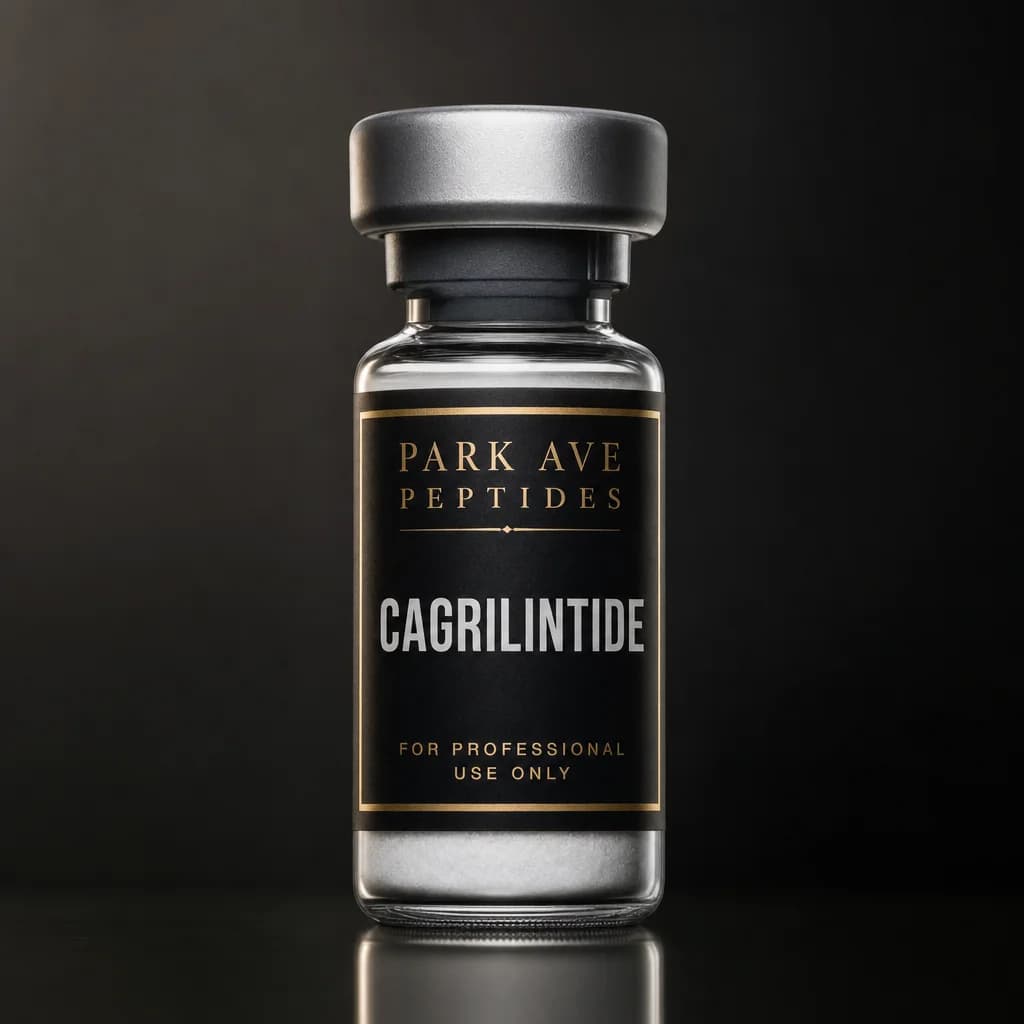
Park Ave Peptides — Clinical Reference Library — For Professional Use Only

Endocrinology · Metabolic Research
Reference Compound
Cagrilintide is a long-acting analog of amylin (islet amyloid polypeptide) engineered with substitutions that prevent fibrillation and a fatty-acid acylation that mediates albumin binding for a once-weekly half-life. The compound binds amylin receptors (AMY1, AMY2, AMY3) — heterodimers of the calcitonin receptor with receptor activity-modifying proteins — and also the calcitonin receptor.
At a Glance
Quality Documentation
Lot PAP-CAGRIL-240118-A01 — Reference
Field of Medicine — Endocrinology · Metabolic Research
Endocrinology and Obesity Research — long-acting amylin analog.
Cagrilintide is a synthetic long-acting analog of amylin, a pancreatic peptide co-secreted with insulin. Lipidation extends its half-life to support weekly dosing in research settings, and it is frequently studied in combination with GLP-1 receptor agonists.
Cagrilintide engages amylin and calcitonin receptor complexes in the area postrema and hypothalamus, contributing to satiety signaling, slowed gastric emptying, and reduced postprandial glucagon. The amylin pathway is complementary to incretin signaling, which is why combination research (e.g. with semaglutide) is an active area.
Reference Compound
Cagrilintide
02 — Science
03 — Pathway
Pathway Summary
Cagrilintide is a long-acting analog of amylin (islet amyloid polypeptide) engineered with substitutions that prevent fibrillation and a fatty-acid acylation that mediates albumin binding for a once-weekly half-life. The compound binds amylin receptors (AMY1, AMY2, AMY3) — heterodimers of the calcitonin receptor with receptor activity-modifying proteins — and also the calcitonin receptor.
Amylin receptor activation slows gastric emptying, suppresses post-prandial glucagon, and engages area postrema and nucleus of the solitary tract neurons that signal satiety. Mechanistically, the amylin pathway is distinct from and complementary to GLP-1 signaling, which is the rationale for the CagriSema combination program with semaglutide.
04 — Lab Reference
For licensed research and clinical evaluation only. Not dosing guidance.
Reconstitution
Bacteriostatic water (0.9% benzyl alcohol) or sterile water. Add diluent slowly along the vial wall — do not inject directly onto the lyophilized cake. Swirl gently until fully dissolved.
Storage
Lyophilized: −20°C long term; 2–8°C short term (weeks). Protect from light.Reconstituted: 2–8°C, generally up to 14–28 days depending on compound.
Quality
≥99% purity by HPLC. Identity confirmed by mass spectrometry. Independent third-party verification on every lot. COA available per lot.
Handling notes —Avoid repeated freeze–thaw cycles. Do not shake vigorously after reconstitution.
Need a full protocol brief?
Reconstitution worksheets, concentration reference cards, and sample COA for verified accounts.
05 — Comparative
See molecular profile, pharmacokinetics, and handling next to related compounds in the same family.
06 — Citations
The following sources are representative of the literature describing Cagrilintide. A full annotated citation list with PubMed identifiers is available on request.
See also the glossary of research terms and the full peptide library.
cGMP facility · Third-party tested · Cold-chain shipping · 24-hour COA on request