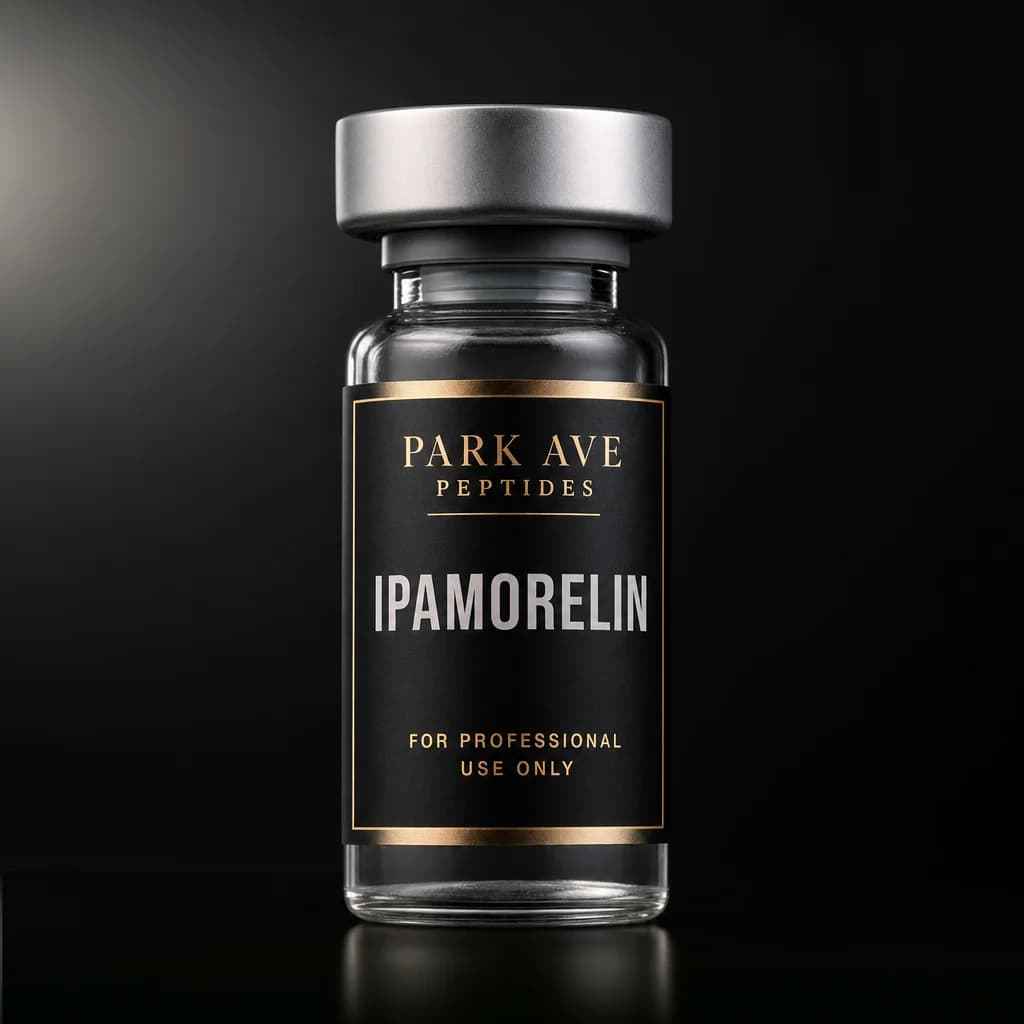
Park Ave Peptides — Clinical Reference Library — For Professional Use Only

Endocrinology · Growth-Hormone Research
Reference Compound
Ipamorelin is a selective growth hormone secretagogue receptor (GHS-R1a) agonist — the same receptor targeted by endogenous ghrelin. The pentapeptide binds GHS-R1a on pituitary somatotrophs and hypothalamic neurons, triggering Gq-mediated phospholipase C activation and pulsatile growth hormone release.
At a Glance
Quality Documentation
Lot PAP-IPAMOR-240118-A01 — Reference
Field of Medicine — Endocrinology · Growth-Hormone Research
Endocrinology — Growth Hormone Secretagogue Research.
Ipamorelin is a selective pentapeptide growth-hormone secretagogue and ghrelin-receptor (GHSR-1a) agonist. It was developed to stimulate pulsatile growth-hormone release without meaningful effects on cortisol, prolactin, or aldosterone — distinguishing it from earlier GHRPs.
Ipamorelin binds the ghrelin/growth-hormone secretagogue receptor on pituitary somatotrophs, triggering a clean, pulsatile release of endogenous growth hormone that mirrors physiologic patterns more closely than continuous GH administration.
Reference Compound
Ipamorelin
02 — Science
03 — Pathway
Pathway Summary
Ipamorelin is a selective growth hormone secretagogue receptor (GHS-R1a) agonist — the same receptor targeted by endogenous ghrelin. The pentapeptide binds GHS-R1a on pituitary somatotrophs and hypothalamic neurons, triggering Gq-mediated phospholipase C activation and pulsatile growth hormone release.
The distinguishing pharmacological feature is selectivity. Unlike ghrelin and earlier GHRPs (GHRP-2, GHRP-6), ipamorelin does not significantly elevate cortisol, prolactin, or aldosterone at standard research doses. This selectivity is the reason ipamorelin is preferred in research protocols studying the GH axis without confounding cortisol response.
Co-administration with a GHRH analog (CJC-1295, tesamorelin) produces an additive GH response — GHRH increases the available pool of releasable GH while ipamorelin triggers the pulse — which is the mechanistic basis of the standard CJC-1295/Ipamorelin research blend.
04 — Lab Reference
For licensed research and clinical evaluation only. Not dosing guidance.
Reconstitution
Bacteriostatic water (0.9% benzyl alcohol) or sterile water. Add diluent slowly along the vial wall — do not inject directly onto the lyophilized cake. Swirl gently until fully dissolved.
Storage
Lyophilized: −20°C long term; 2–8°C short term (weeks). Protect from light.Reconstituted: 2–8°C, generally up to 14–28 days depending on compound.
Quality
≥99% purity by HPLC. Identity confirmed by mass spectrometry. Independent third-party verification on every lot. COA available per lot.
Handling notes —Avoid repeated freeze–thaw cycles. Do not shake vigorously after reconstitution.
Need a full protocol brief?
Reconstitution worksheets, concentration reference cards, and sample COA for verified accounts.
05 — Comparative
See molecular profile, pharmacokinetics, and handling next to related compounds in the same family.
06 — Citations
The following sources are representative of the literature describing Ipamorelin. A full annotated citation list with PubMed identifiers is available on request.
See also the glossary of research terms and the full peptide library.
cGMP facility · Third-party tested · Cold-chain shipping · 24-hour COA on request