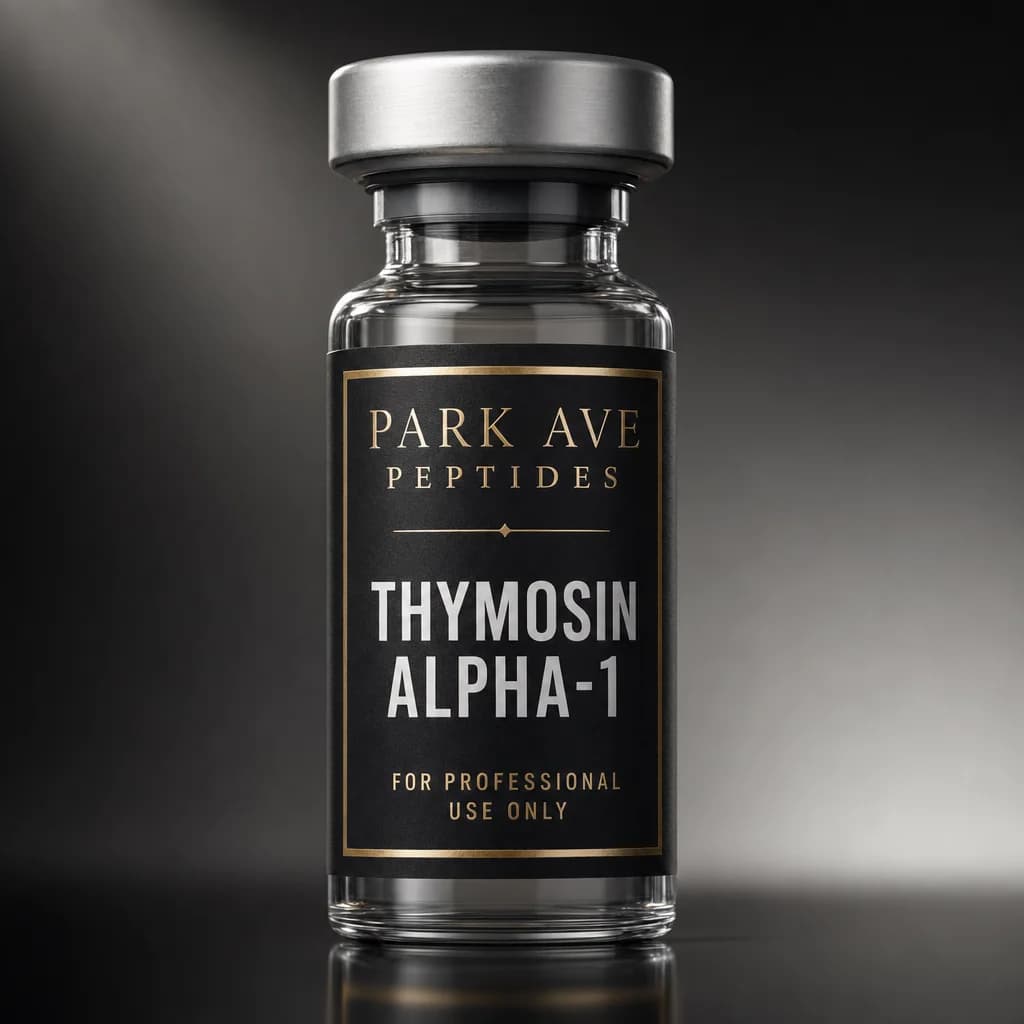
Park Ave Peptides — Clinical Reference Library — For Professional Use Only

Immunology · Host-Defense Research
Reference Compound
Thymosin α-1 is a 28-amino-acid acetylated peptide originally isolated from thymic tissue and synthesized as a synthetic identical sequence (thymalfasin) for clinical research. The peptide is a fragment of prothymosin α and is recognized as a thymus-derived immune-modulating compound.
At a Glance
Quality Documentation
Lot PAP-THYMOS-240118-A01 — Reference
Field of Medicine — Immunology · Host-Defense Research
Immunology and Infectious-Disease Research.
Thymosin Alpha-1 (Tα1) is a 28–amino-acid peptide originally isolated from thymic tissue. It is one of the most extensively studied immunomodulatory peptides and is approved in several countries as a clinical therapeutic for specific viral and oncologic indications.
Tα1 acts primarily through Toll-like receptor 9 (TLR9) and TLR2 signaling on dendritic cells, promoting maturation, T-helper-1 polarization, and cytotoxic T-cell activity. It enhances natural killer cell activity and modulates regulatory T-cell balance.
Reference Compound
Thymosin Alpha-1
02 — Science
03 — Pathway
Pathway Summary
Thymosin α-1 is a 28-amino-acid acetylated peptide originally isolated from thymic tissue and synthesized as a synthetic identical sequence (thymalfasin) for clinical research. The peptide is a fragment of prothymosin α and is recognized as a thymus-derived immune-modulating compound.
Mechanism of action centers on Toll-like receptor 9 (TLR9) and MyD88-dependent signaling in dendritic cells, with downstream effects on Th1 differentiation, natural killer cell cytotoxicity, and CD8+ T cell response. The peptide enhances dendritic cell maturation and antigen presentation, supporting cell-mediated immunity in immunosuppressed states.
Thymosin α-1 holds regulatory approval in over 30 countries (notably for hepatitis B), and the clinical trial record includes oncology adjuvant settings, viral infection, and sepsis.
04 — Lab Reference
For licensed research and clinical evaluation only. Not dosing guidance.
Reconstitution
Bacteriostatic water (0.9% benzyl alcohol) or sterile water. Add diluent slowly along the vial wall — do not inject directly onto the lyophilized cake. Swirl gently until fully dissolved.
Storage
Lyophilized: −20°C long term; 2–8°C short term (weeks). Protect from light.Reconstituted: 2–8°C, generally up to 14–28 days depending on compound.
Quality
≥99% purity by HPLC. Identity confirmed by mass spectrometry. Independent third-party verification on every lot. COA available per lot.
Handling notes —Avoid repeated freeze–thaw cycles. Do not shake vigorously after reconstitution.
Need a full protocol brief?
Reconstitution worksheets, concentration reference cards, and sample COA for verified accounts.
05 — Comparative
See molecular profile, pharmacokinetics, and handling next to related compounds in the same family.
06 — Citations
The following sources are representative of the literature describing Thymosin Alpha-1. A full annotated citation list with PubMed identifiers is available on request.
See also the glossary of research terms and the full peptide library.
cGMP facility · Third-party tested · Cold-chain shipping · 24-hour COA on request