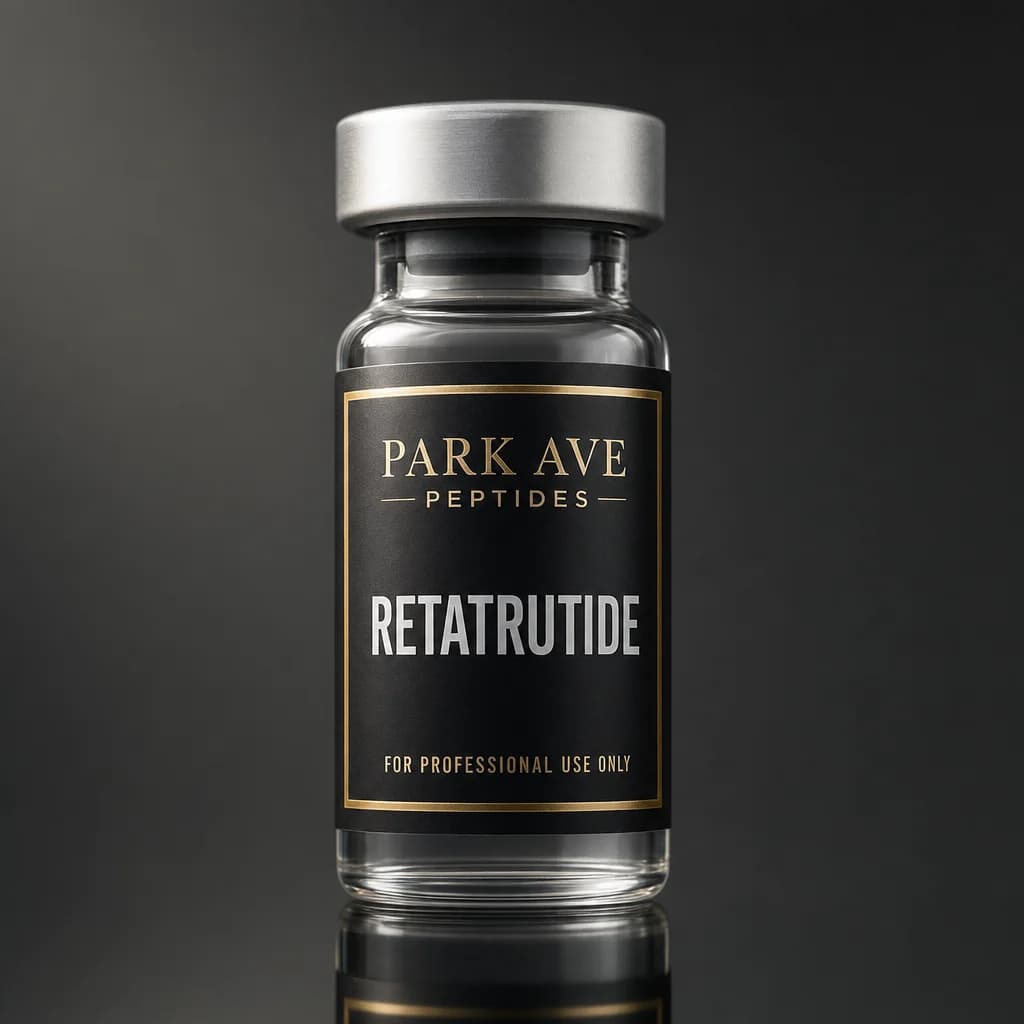
Park Ave Peptides — Clinical Reference Library — For Professional Use Only

Endocrinology · Metabolic Research
cGMP facility · Third-party tested · Cold-chain shipping · 24-hour COA on request
Reference Compound
Retatrutide (LY3437943) is a 39-amino-acid triple agonist of the GLP-1, GIP, and glucagon receptors. The peptide carries a fatty-acid moiety for albumin binding and once-weekly pharmacokinetics, and the receptor balance is engineered for substantial agonism at all three targets — distinguishing it from selective GLP-1 agonists and from GIP/GLP-1 dual agonists.
At a Glance
ShowQuality Documentation
Lot PAP-RETATR-240118-A01 — Reference
Field of Medicine — Endocrinology · Metabolic Research
Endocrinology and Obesity Medicine — investigational triple incretin agonist.
Retatrutide is an investigational synthetic peptide acting as a triple agonist at the GLP-1, GIP, and glucagon receptors. It represents an evolution beyond single- and dual-incretin therapeutics, recruiting glucagon receptor activity in addition to the two incretin pathways.
Simultaneous activation of GLP-1 and GIP receptors drives glucose-dependent insulin release, glucagon suppression at meals, delayed gastric emptying, and central appetite reduction. Concurrent glucagon-receptor agonism is thought to increase energy expenditure and promote hepatic lipid mobilization, contributing to additive weight reduction in preclinical and clinical research.
Early-phase clinical data have reported some of the largest weight-loss effects observed in the incretin class to date, generating significant interest in tri-agonist pharmacology.
Reference Compound
Retatrutide
02 — Science
03 — Pathway
Pathway Summary
Retatrutide (LY3437943) is a 39-amino-acid triple agonist of the GLP-1, GIP, and glucagon receptors. The peptide carries a fatty-acid moiety for albumin binding and once-weekly pharmacokinetics, and the receptor balance is engineered for substantial agonism at all three targets — distinguishing it from selective GLP-1 agonists and from GIP/GLP-1 dual agonists.
The glucagon receptor arm is the principal mechanistic distinction. Hepatic glucagon receptor activation increases energy expenditure, promotes hepatic fatty acid oxidation, and reduces hepatic steatosis in preclinical models. The combination of glucagon-driven energy expenditure with incretin-driven appetite suppression is the hypothesized basis for the larger weight-loss effects reported in Phase 2 trials.
Receptor potency reports indicate near-equipotent GLP-1 and glucagon activity with somewhat lower GIP potency, though formulations vary across the published literature.
04 — Lab Reference
For licensed research and clinical evaluation only. Not dosing guidance.
Reconstitution
Bacteriostatic water (0.9% benzyl alcohol) or sterile water. Add diluent slowly along the vial wall — do not inject directly onto the lyophilized cake. Swirl gently until fully dissolved.
Storage
Lyophilized: −20°C long term; 2–8°C short term (weeks). Protect from light.Reconstituted: 2–8°C, generally up to 14–28 days depending on compound.
Quality
≥99% purity by HPLC. Identity confirmed by mass spectrometry. Independent third-party verification on every lot. COA available per lot.
Handling notes —Avoid repeated freeze–thaw cycles. Do not shake vigorously after reconstitution.
Need a full protocol brief?
Reconstitution worksheets, concentration reference cards, and sample COA for verified accounts.
05 — Common Questions
Retatrutide is presented here as a reference compound for clinicians and researchers. Regulatory status varies by jurisdiction and indication — see the official drug databases (FDA, EMA) for current approval information.
Yes. A lot-specific COA documenting identity and purity by HPLC and mass spectrometry is available on request through the Request Information form.
Each lot is analyzed by reverse-phase HPLC for purity and confirmed by mass spectrometry for identity. Independent third-party laboratory verification is performed on every lot.
Store the lyophilized vial refrigerated for short-term use, or frozen at −20°C for long-term storage. Once reconstituted, refrigerate and protect from light.
06 — Citations
The following sources are representative of the literature describing Retatrutide. A full annotated citation list with PubMed identifiers is available on request.
See also the glossary of research terms and the full peptide library.
Comparative Reference
See molecular profile, pharmacokinetics, and handling next to related compounds in the same family.
Often Researched Alongside
cGMP facility · Third-party tested · Cold-chain shipping · 24-hour COA on request